Alex Whitehead/SWpix.com
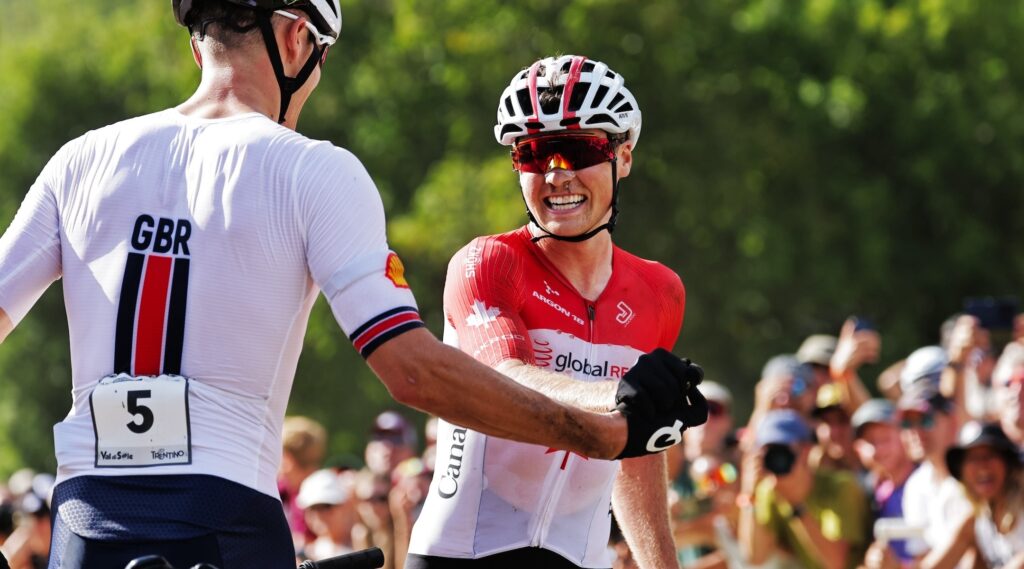
Cole Punchard made a memorable debut as an elite racer at the UCI Mountain Bike World Championships on Sunday, winning bronze in the men’s Elite Cross-Country Olympic (XCO) final in Val di Sole, Italy.
The 22-year-old from Novar, Ontario, crossed the finish line in 1:25:57, just 31 seconds behind gold medallist Thomas Pidcock of Great Britain, to secure his first elite world championship medal. British cyclist Charlie Aldridge finished with silver (1:25:43).
-

Cole Punchard celebrates a bronze medal in the Elite Men’s XCO at the 2026 UCI Mountain Bike World Championships. Photo by Photo by Alex Whitehead/SWpix.com -
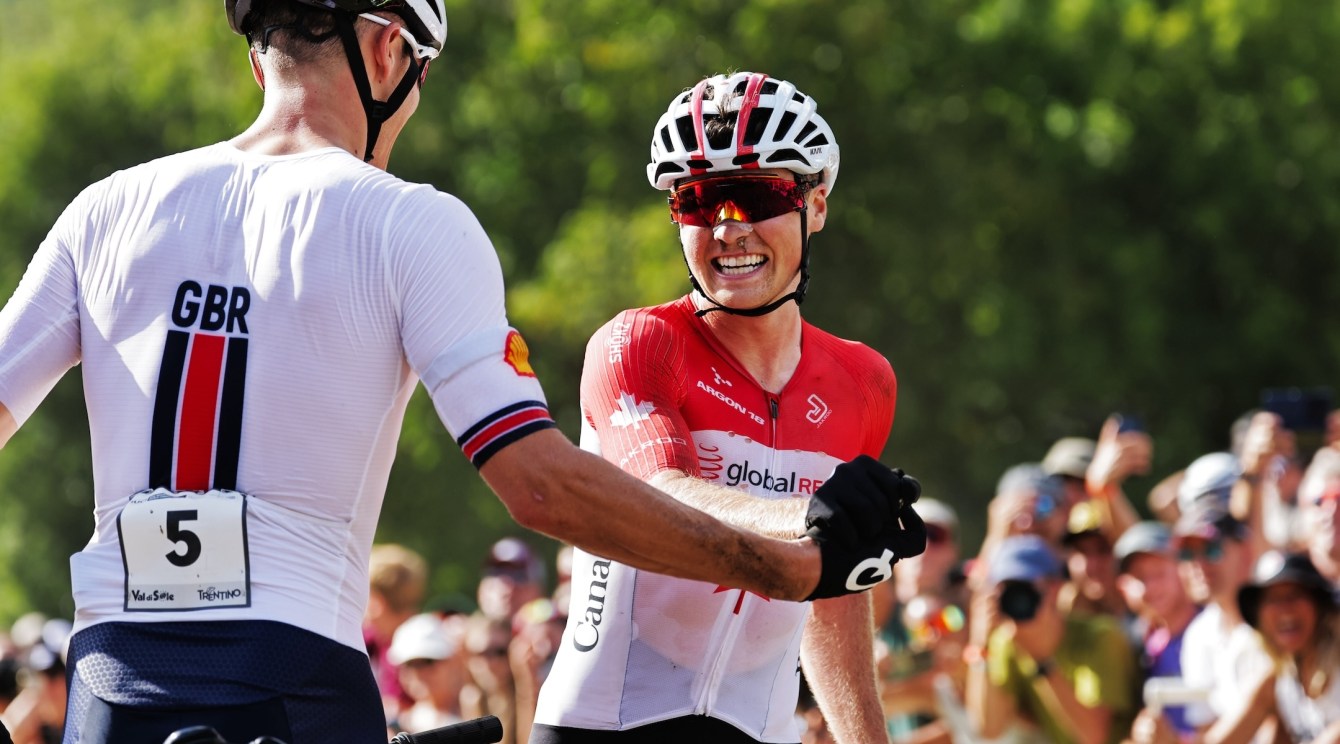
Cole Punchard celebrates a bronze medal in the Elite Men’s XCO at the 2026 UCI Mountain Bike World Championships. Photo by Alex Whitehead/SWpix.com
Starting near the front of the field, Punchard quickly established himself among the race leaders, moving into a group of eight at the front during the opening lap. He remained in contention through the early stages before slipping back from the lead group midway through the race. Punchard continued to push and steadily worked his way back toward the front, ultimately securing third place and the bronze medal.
Reflecting on his decision in 2025 to race in the Elite category at Canadian Championships while still eligible for U23 competition, Punchard said, “It was a bit scary, because I mean, you’re just gonna get the crap kicked out of you for an entire year,” he told Canadian Cycling Magazine. “But I thought that in the long term, this would be better for me.”
The bronze adds to a strong 2026 season for Punchard, who finished seventh at the UCI Mountain Bike World Cup in YongPyong, ninth in Les Gets, and won silver in the Elite Men’s XCO race at the Canadian National Championships.
Punchard previously won silver in the U23 XCO and bronze in the U23 XCC at the 2025 UCI Mountain Bike World Championships.
His bronze medal marks a career highlight for Punchard, making him the first Elite Male to win an XCO medal at the Mountain Bike World Championships since Ryder Hesjedal in 2003.
On Sunday, Isabella Holmgren was the top Canadian finisher in the women’s Elite Cross-country Olympic final, placing 12th.
PakarPBN
A Private Blog Network (PBN) is a collection of websites that are controlled by a single individual or organization and used primarily to build backlinks to a “money site” in order to influence its ranking in search engines such as Google. The core idea behind a PBN is based on the importance of backlinks in Google’s ranking algorithm. Since Google views backlinks as signals of authority and trust, some website owners attempt to artificially create these signals through a controlled network of sites.
In a typical PBN setup, the owner acquires expired or aged domains that already have existing authority, backlinks, and history. These domains are rebuilt with new content and hosted separately, often using different IP addresses, hosting providers, themes, and ownership details to make them appear unrelated. Within the content published on these sites, links are strategically placed that point to the main website the owner wants to rank higher. By doing this, the owner attempts to pass link equity (also known as “link juice”) from the PBN sites to the target website.
The purpose of a PBN is to give the impression that the target website is naturally earning links from multiple independent sources. If done effectively, this can temporarily improve keyword rankings, increase organic visibility, and drive more traffic from search results.